Choosing a driving instructor is one of the most consequential decisions a new driver — or a professional seeking to advance their skills — will make. The instructor who sits beside you during your formative hours behind the wheel will either build habits that protect you for decades or embed errors that put you and others at risk.
This guide is written for individuals seeking quality instruction, for parents researching schools for their children, and for employers evaluating training providers. It draws on CTSDA accreditation standards and decades of industry experience to give you a clear, practical framework.
Why the Right Instructor Matters More Than You Think
Driving instruction is a teaching profession, not just a supervision role. Research consistently shows that driver behaviour patterns established in the first 50 hours of driving experience are extraordinarily difficult to change later. Poor technique, risk tolerance, and decision-making habits formed during training persist for years — sometimes for life.
This is why the professional quality of the instructor, not just the price of the course, must be the central criterion in your decision.
Step 1: Verify Credentials and Licensing
Before considering any other factors, confirm that the instructor holds all required licences and certifications for your jurisdiction. In the United States, requirements vary by state but typically include:
- A valid, full driving licence with a clean record (typically zero points or a maximum threshold)
- A background check clearance, especially for instructors working with minors
- State-issued driving instructor certification or a professional driving instructor (PDI) credential
- For commercial vehicle instruction: appropriate CDL class with relevant endorsements (T, P, X, N, etc.)
- Affiliation with an accredited driving school
CTSDA-accredited schools are independently verified to meet rigorous standards covering instructor qualifications, curriculum quality, vehicle maintenance, and student outcomes. Always ask if a school holds CTSDA accreditation or equivalent third-party certification.
Step 2: Assess Teaching Methodology
There is a profound difference between an instructor who grabs the wheel and an instructor who teaches. The best instructors use a structured, evidence-based teaching methodology known as the GDE (Goals for Driver Education) framework, which progressively develops:
- Vehicle handling skills — the mechanics of controlling the vehicle
- Mastery of traffic situations — reading and responding to road environments
- Journey planning and execution — route planning, risk assessment, and adapting to circumstances
- Personal goals and risk awareness — understanding one's own risk attitudes and how they affect driving behaviour
Ask prospective instructors to describe their teaching approach. If they cannot articulate a method beyond "I'll show you how to do it," consider that a warning sign.
Step 3: Evaluate the School's Record and Reputation
Data matters. When evaluating a driving school, request the following information:
- First-time pass rate for practical tests
- Average number of hours required to reach test standard
- Number of students trained per year
- Number of complaints filed with the state licensing authority
- Reviews from former students on verifiable platforms (Google, Yelp, BBB)
Be sceptical of schools that cannot or will not provide pass rate data. Reputable schools are proud of their outcomes and transparent about their performance.
Step 4: Inspect the Training Vehicles
A professional school invests in its fleet. Training vehicles should be:
- Well-maintained with current MOT/inspection certificates
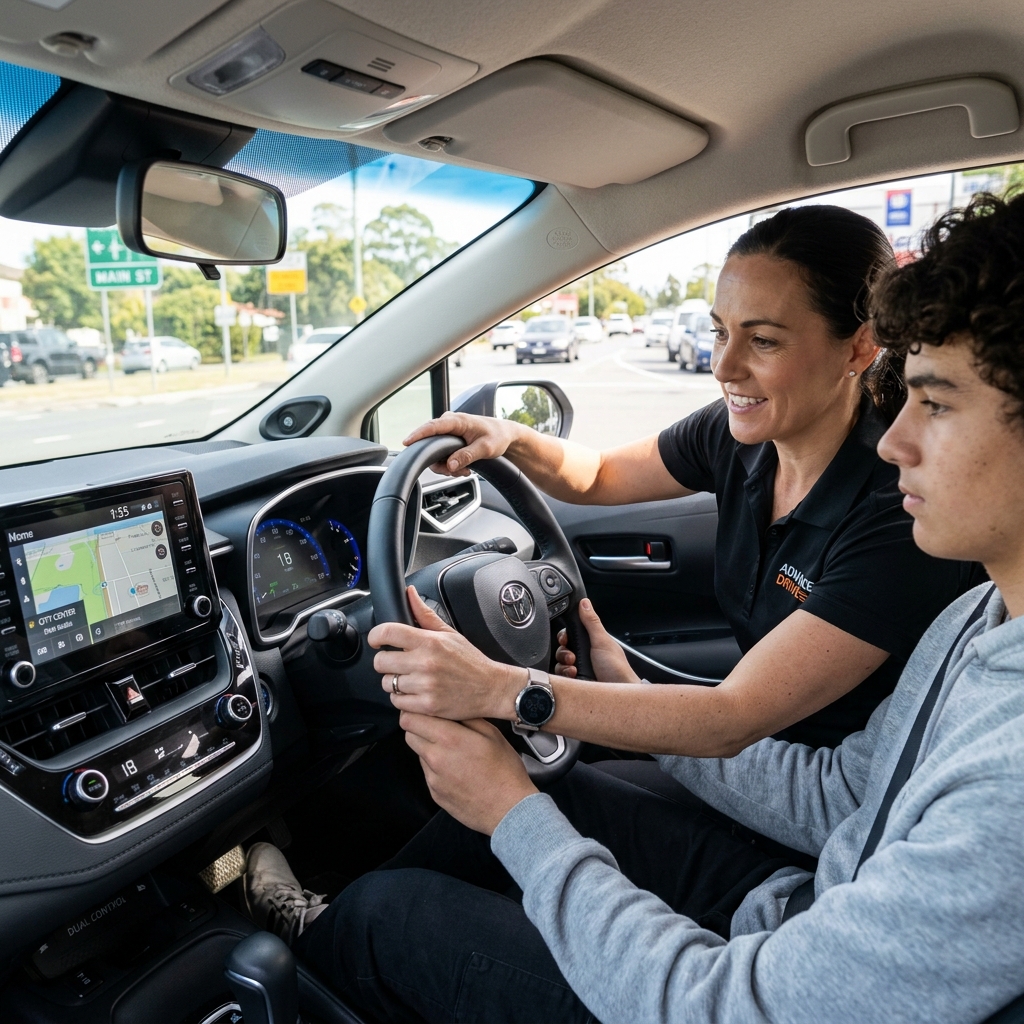
- Equipped with dual controls (instructor-side pedals) — this is mandatory for safety
- Clean and professional in presentation — a school's vehicles reflect its standards
- Appropriate to the licence class being pursued (e.g., actual CDL-eligible trucks for commercial training)
Step 5: Take a Trial Lesson
Most reputable schools offer an introductory lesson at a reduced rate. This is not just a sales tactic — it is an essential opportunity to evaluate whether the instructor is patient, articulate, encouraging, and genuinely focused on your development as a driver.
During your trial lesson, consider:
- Does the instructor explain the reasoning behind instructions, or just give commands?
- Do they respond calmly to mistakes, or with frustration?
- Do they check in on your understanding, or assume you've absorbed everything?
- Do they maintain professional conduct throughout?
Red Flags to Watch For
The following should raise serious concerns about any school or instructor:
- Reluctance to provide credentials or licence numbers
- No dual-control vehicle
- Unusually low prices with no clear explanation (quality instruction costs money to deliver)
- Pressure to purchase large lesson packages upfront before a trial lesson
- Negative reviews citing unsafe behaviour, aggression, or unprofessionalism
- No formal curriculum or syllabus provided
A Note on CTSDA Accreditation
The CTSDA accreditation programme exists precisely to solve the problem of quality assurance in driver education. Our rigorous, independent assessment process evaluates every dimension of a training school's operation — from instructor qualifications and vehicle standards to curriculum content and student outcomes.
When you see the CTSDA accreditation mark, you can be confident that the school has been independently verified to meet a high professional standard. Search our directory of accredited schools to find a verified training provider in your area.
Conclusion
The right driving instructor is worth every penny. The wrong one can create habits that put lives at risk for decades. Use the framework in this guide to make an informed, confident decision — and always choose accredited.